
Dongguan, Guangdong, China – November 17, 2026
Hey there! So, China’s wire-forming industry is a big deal – it fuels everything from cars to appliances, construction, and even hardware. If you’re shopping around for bending wire tools, this guide rounds up ten Chinese manufacturers that are worth a look, especially if you’re comparing equipment and the support they offer. Just a heads-up: a machine that handles thin stainless steel wire might not be the best for thicker spring steel. So, always test it with your actual job, not just what the brochure says.Honestly, when you’re comparing machines, you’ve got to look at the practical stuff – like what wire diameters it can handle, the material range, how accurate the bends are, how long it takes to switch over, and what kind of controls you get. But here’s the thing: don’t just take their word for it. Ask suppliers to send you sample parts made from your own wire. Then really scrutinize them – check the bend angles, look for any surface marks, and run the machine through several cycles to see if the results are consistent. You might think little differences don’t matter, but trust me, they add up. So when you’re shopping around for a wire bending tool, it’s tempting to go for the one with the most features, right? But honestly, what really matters is whether it actually fits your output needs and your shop-floor workflow — not just how many cool things it can do. You should definitely ask what’s included in the deal: like the tooling, installation guidance, spare parts, and even operator training. And don’t forget to ask for clear specs and get everything in writing before you make your final call. That way you’re not left guessing later.You know, you can’t just take a manufacturer’s word for it—claims need to be verified. A slick product page might look great, but it won’t tell you how that machine actually holds up during a full shift on the production floor. Factory visits, video demos, and talking to existing customers can really help you get a sense of what’s real, though getting access to those isn’t always easy. And when you’re comparing quotes, make sure you’re looking at apples-to-apples—same technical specs, including tooling and what kind of after-sales support you’ll get. This ranking-style overview is just a jumping-off point, honestly, not a substitute for hands-on testing. Plus, things can change as product lines and service deals shift over time, so keep that in mind. Hey, that’s definitely worth keeping in mind. So you’ve got these profiles – use them to shortlist your suppliers. But then, don’t just pick one; you need to run each option against your actual wire samples, how much you’re planning to produce, and the quality standards you’re aiming for. That way you’re not missing anything.
 Definition and Classification of Bending Wire Tools in China
A Bending Wire Tool is equipment used to shape wire into controlled angles, curves, loops, or formed components. The term covers simple hand tools as well as powered production machines. It does not describe one fixed design. A small bench jig may bend a few parts, while a programmable machine can repeat complex profiles across larger batches. Small details matter. Wire diameter, material hardness, bend radius, and springback all affect the finished shape. A bend that looks correct before release may open slightly afterward.Bending wire tools can be classified by operation and level of control. Hand tools, such as pliers and manual bending forms, suit prototypes and low-volume work. Bench-mounted jigs provide more repeatable angles, especially when stops or pins locate the wire. Powered machines use mechanical or servo-driven motion for faster, consistent forming. CNC wire benders add programmed feed, rotation, and bend sequences for multi-plane parts. Not always. More automation does not automatically mean better results; setup accuracy and tooling condition remain important. In practice, engineers often test a sample, measure its bend angles, and adjust for springback. Classification helps compare equipment, but it cannot replace testing the actual wire and part geometry.
China Bending Wire Tools: Definition and Classification
Reference wire diameters for selecting bending tools
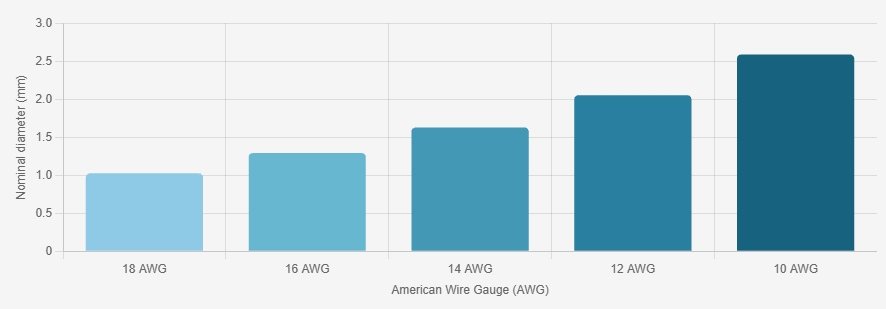
Bending wire tools shape wire through manual, press-based, or CNC-controlled operations. This chart shows the nominal diameters corresponding to common AWG sizes, converted to millimeters; it is a wire-size reference, not a specification of any tool’s capacity. Actual bending capability depends on tool design, wire material, and bend radius.
When comparing China’s top bending wire tool manufacturers, focus on process data, not just machine size. Ask for the usable wire-diameter range and test it with your actual material. A 2 mm steel wire may feed smoothly, while the same diameter in a springier alloy can drift or twist. Small differences matter.
Bend radius needs a clear definition. Confirm whether the stated value refers to the inside radius, and request a sample part for inspection. A Wire Bending Jig Tool should hold the wire securely without leaving deep marks. Check repeatability across several pieces, not one polished sample. One test is not enough.
Axis count affects what the machine can form, but more axes do not guarantee better output. Match them to the part’s bends, rotations, and feed path. Cycle rate should include loading, cutting, and forming—not only the fastest isolated movement. Ask for a timed run using your drawing and production material. Record the result. Even then, setup skill and wire variation can change the rate; this is easy to underestimate.
Quality Benchmarks: ISO 9001:2015 and IATF 16949:2016
For China’s top bending-wire tool manufacturers, quality claims should be checked against documented controls, not polished brochures. ISO’s ISO Survey 2022 recorded 1,265,216 valid ISO 9001 certificates worldwide. That figure shows broad adoption, not guaranteed product quality. A certificate covers a management system; it does not prove every Steel Wire Bending Tool will hold a tight bend radius or repeat dimensions across shifts.Ask for current certificate scope, audit status, and records tied to the actual production site. IATF 16949:2016 adds automotive supply-chain requirements for traceability, process risk, and corrective action. Its certification data tracks sites and oversight, not the accuracy of a specific machine setup. Check calibration logs, sample inspection reports, and change-control records. Look closely. A practical test is a batch of bent samples measured against your drawing, including wire diameter, angle, and springback. Request evidence of how rejected parts are isolated and how causes are investigated. A neatly stamped certificate is useful, but it cannot replace that evidence. One weakness in many comparisons is relying on a certificate image without checking its validity and scope. ISO Survey 2022 and IATF oversight reports provide context; factory records reveal day-to-day discipline.
China’s Top 10 Manufacturers: Product Range, Capacity, and Technical Data
China Top 10 Bending Wire Tool Manufacturers: Product Range, Capacity, and Technical DataComparing China’s leading bending-wire tool manufacturers takes more than counting models. Check whether their product ranges include 2D and 3D CNC benders, straightening and cutting units, and feeding systems. Numbers matter. Ask for the supported wire diameter, material type, bending axes, feed speed, repeatability, and changeover time. Capacity should be stated for a specific part and material, not just as a headline production rate. A small spring and a complex three-dimensional frame can run at very different speeds. Request a sample cycle using your own drawing, plus the part dimensions and scrap rate. A polished catalog is not a capacity audit.The World Steel Association’s World Steel in Figures 2025 reports that China produced 1,005.1 million tonnes of crude steel in 2024. That scale indicates a substantial industrial base, but it does not prove any individual machine supplier’s output or quality. For incoming wire, ISO 6892-1:2019 provides a method for tensile testing metallic materials; ask how feedstock properties are checked before trials. Compare machine power, footprint, tooling requirements, software, and service response alongside rated speed. This comparison has limits: geometry and setup can change real cycle times. Still, verified test data is more useful than a brochure promise.
China Top 10 Bending Wire Tool Manufacturers – China’s Top 10 Manufacturers: Product Range, Capacity, and Technical Data
This anonymous comparison presents ten common machine-capability profiles rather than verified, ranked company specifications. Figures are indicative ranges found across industrial machine configurations; actual limits depend on machine model, wire material, tooling, and part geometry. Production output is job-dependent and is not directly comparable between machines.
| Profile | Typical Product Range | Wire Size Range | Typical CNC Axes | Indicative Feed-Speed Range | Capacity and Technical Notes |
|---|---|---|---|---|---|
| 1. Compact 2D CNC bender | Clips, hooks, simple brackets, and flat-plane wire forms | Approximately 1–3 mm round wire | 2–3 axes | Approximately 30–60 m/min | Suitable for smaller parts and repeat production. Output depends on bend count, part length, and feed configuration. |
| 2. Standard 2D CNC bender | Wire loops, retaining clips, appliance components, and automotive forms | Approximately 2–6 mm round wire | 3–4 axes | Approximately 20–60 m/min | Common configuration for medium-gauge wire. Cut-off method and tooling affect achievable cycle time. |
| 3. High-speed 2D bender | High-volume clips, hooks, small fasteners, and repetitive wire shapes | Approximately 1–4 mm round wire | 3–5 axes | Approximately 40–100 m/min | Higher feed speed does not equal finished-parts-per-minute; part geometry and forming sequence determine actual output. |
| 4. 3D CNC wire bender | Three-dimensional brackets, supports, frames, and formed assemblies | Approximately 2–6 mm round wire | 5–8 axes | Approximately 15–50 m/min | Uses multi-directional forming to produce bends in more than one plane; setup and tooling are part-specific. |
| 5. Multi-axis 3D bender | Complex automotive, furniture, and industrial wire components | Approximately 3–8 mm round wire | 8–12 axes | Approximately 10–40 m/min | Additional axes can enable more complex forming sequences, but do not by themselves guarantee higher production capacity. |
| 6. Heavy-wire CNC bender | Reinforcement components, heavy brackets, and structural wire forms | Approximately 5–12 mm round wire | 6–12 axes | Approximately 5–30 m/min | Requires appropriately sized feed, straightening, cutting, and forming systems. Maximum wire size varies with tensile strength and bend radius. |
| 7. Fine-wire precision bender | Small springs, electronic components, precision clips, and medical-device subcomponents | Approximately 0.3–2 mm round wire | 4–8 axes | Approximately 10–60 m/min | Fine-wire performance depends on material condition, straightening accuracy, and control of springback. |
| 8. Spring and wire-forming machine | Compression and extension springs, torsion springs, and formed wire parts | Approximately 0.2–3 mm round wire | 4–8 axes | Model- and part-dependent | Spring production uses coiling and forming operations; cycle rate varies substantially with spring design and material. |
| 9. Flat-wire forming machine | Flat-wire clips, contacts, retaining parts, and formed strip components | Flat or rectangular wire; size is specified by width and thickness | 3–8 axes | Model- and part-dependent | Round-wire diameter ratings are not directly applicable. Specify cross-section, material, and minimum bend radius when comparing machines. |
| 10. Automated bending cell | Complex formed components with cutting, transfer, inspection, or robotic handling | Commonly about 2–10 mm round wire, subject to cell design | Machine axes plus optional robot axes | Job- and layout-dependent | Cell capacity depends on the complete process, including loading, handling, inspection, and downstream operations; it must be established through application testing. |
Applications in Automotive, Construction, Furniture, and Appliance Manufacturing
Automotive production uses bent wire in seat frames, head-rest supports, pedal assemblies, and small retaining clips. A controlled bend radius helps prevent cracks, while repeatable positioning keeps parts aligned during assembly. Small errors show. Even a slight change in springback can leave a bracket sitting unevenly. Manufacturers often test sample parts with the actual wire grade and diameter before setting production tooling.
Construction applications include wire hooks, mesh components, fasteners, and supports for building systems. These parts may face vibration or outdoor exposure, so bend consistency and surface condition matter. Furniture makers use shaped wire in chair frames, shelving, and mattress components, where smooth curves affect both comfort and appearance. Fit matters.
In appliance manufacturing, wire forms appear in racks, guards, handles, and internal supports. A tool must produce accurate shapes without scraping coatings or leaving sharp edges. Simple checks help: compare bend angles, inspect contact points, and measure a small batch after setup. Still, a good first sample does not guarantee stable output all day. Wire coils can vary, and worn guides may shift the path gradually. That part is easy to miss.
Supplier Comparison Metrics: Accuracy, Throughput, Tool Life, and Service
China Top 10 Bending Wire Tool ManufacturersCompare suppliers using repeatable shop-floor tests, not brochure claims. For accuracy, ask each maker to bend the same wire batch and measure springback, angle, and leg length. Record results across several runs; one perfect sample proves little. For throughput, count accepted parts per hour, including setup and changeovers. Tool life should mean usable bends before maintenance or quality drift, not simply total cycles. Ask for service response times, spare-part lead times, and a named technical contact. Deloitte’s 2024 Smart Manufacturing Survey found that 86% of manufacturers viewed smart manufacturing solutions as future competitiveness drivers. That is a useful signal, not proof that any machine will meet your target.Tips: Put the test conditions in writing. Specify wire diameter, material, bend radius, and tolerances. A Copper Wire Bending Tool may perform differently when copper temper or coil tension changes. Keep sample parts from each trial, then inspect them with the same gauge. Compare the data—and note what was not tested. Real production is messier than a demo.
10-Axis CNC Camless Spring Forming: Industry Trends Informed by the IFR World Robotics Report
10 Axes CNC Camless Spring Forming Machine – China Suppliers & Factory for Wire Range 0.2-2.5mm
Ten-axis CNC camless spring forming reflects a broader manufacturing shift toward flexible, digitally controlled production. The IFR’s *World Robotics 2024* report recorded 541,302 industrial robot installations worldwide in 2023, the second-highest annual total on record, with the global operational stock reaching approximately 4.28 million. While these figures cover industrial robots broadly—not spring-forming machines specifically—they point to growing investment in automation. In spring production, independently controlled axes can support complex geometries and quick program changes, while camless operation can reduce mechanical setup requirements and help manufacturers respond to varied order sizes.For buyers evaluating this equipment, consistency, durability, and dependable supplier support matter alongside automation capabilities. Our products are sourced from trusted suppliers in China, and our factory applies modern production techniques and rigorous quality checks to support reliable performance. Working with established industry partners helps us offer competitively priced options without compromising on quality. As manufacturers explore more adaptable production systems, a carefully selected 10-axis CNC camless spring former can be a practical addition to a broader automation strategy.
Conclusion
This article presents a practical overview of China’s Bending Wire Tool industry, beginning with the definition and classification of equipment used to shape wire into components and finished products. It explains the key process data buyers should evaluate, including wire diameter, minimum bend radius, number of working axes, and cycle rate. It also outlines the role of ISO 9001:2015 and IATF 16949:2016 quality systems in assessing manufacturing consistency and process control.The article compares ten manufacturer profiles by product range, production capacity, and available technical specifications, without focusing on brand promotion. It also considers how bending wire equipment serves automotive, construction, furniture, and appliance manufacturing. To support supplier evaluation, the guide highlights accuracy, throughput, tool life, and after-sales service as practical comparison metrics, helping readers match machine capabilities to production requirements and make informed sourcing decisions.
About Us
EASTON PRECISION TECHNOLOGY (DONGGUAN) CO.,LTD. (briefly brand name SMS) is a Chinese based company that have been delivering quality and reliability since 2019 . We are an Innovative and modern company Committed to delivering the newest Technology at the very highest standards. Our innovative designs and reliability, have seen us to grow and expand our product range enabling us to supply all major global markets.
Media Contact
Company Name: EASTON PRECISION TECHNOLOGY (DONGGUAN) CO.,LTD.
Contact Person: Media Relations
Email: Send Email
Country: China
Website: https://www.smswiressolution.com/
Press Release Distributed by ABNewswire.com
To view the original version on ABNewswire visit: Industry Report Reveals Leading Chinese Bending Wire Tool Manufacturers
Media gallery



