
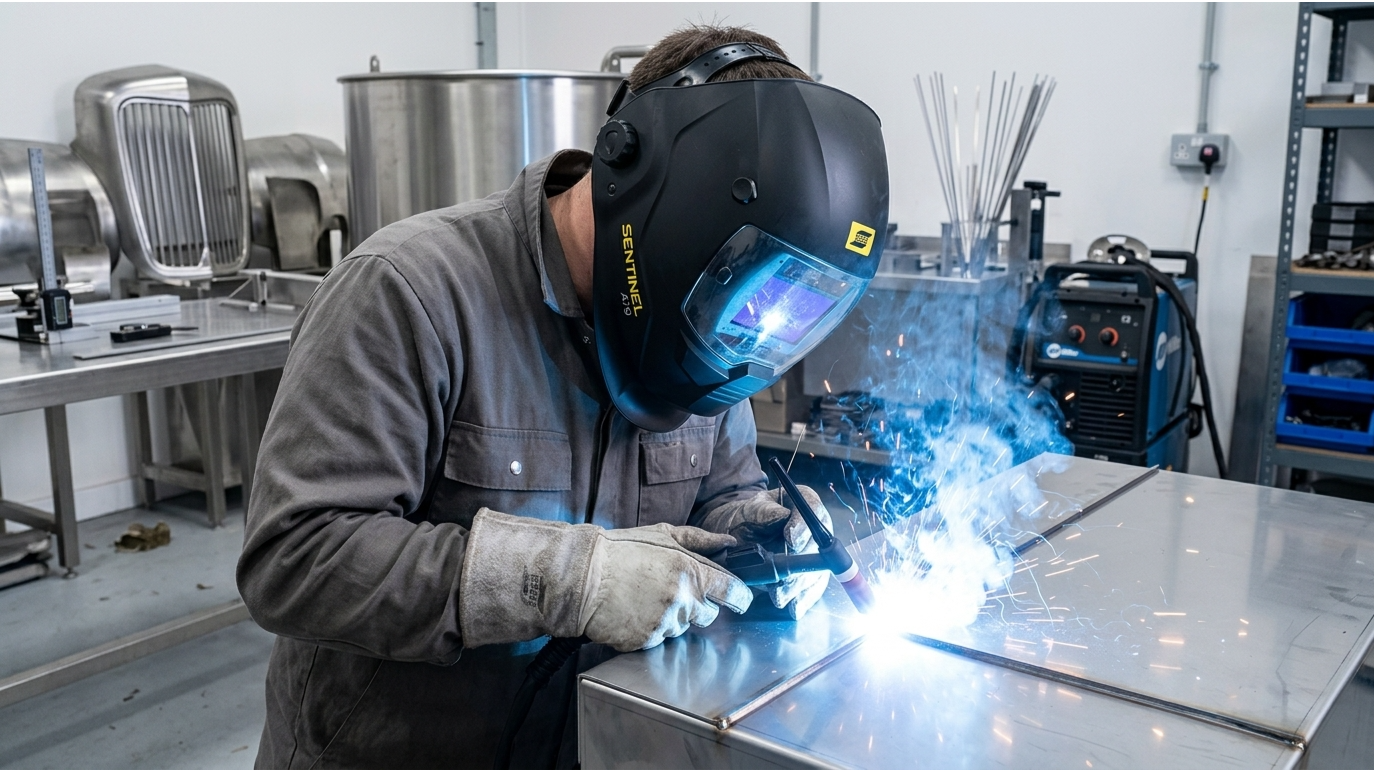
Many professional welders assume air-fed masks are only for specialist jobs, but HSE rules now require fume control for every welding task. Drawing on insight from welding supplier Weldtech UK, this guide explains what the rules require and when an air-fed mask becomes the practical choice.
Why Welding Fume Rules Changed
In February 2019, the Health and Safety Executive (HSE) issued a safety alert after the International Agency for Research on Cancer classified all welding fume, including mild steel fume, as a Group 1 carcinogen linked to lung cancer.
HSE tightened its enforcement expectations in response, stating that there is no known safe level of exposure to welding fume and that general ventilation does not achieve adequate control. Those fumes are still causing acute lung infections and metal fume fever that hospitalise dozens of workers annually. Chronic exposure is estimated by HSE to cause more than 150 welding-related cancer deaths in the UK each year.
What the Law Actually Requires
The legal duty sits under the Control of Substances Hazardous to Health Regulations 2002 (COSHH). Employers must assess the risk from welding fume and put adequate controls in place for every task, however short, indoors or outdoors.
The law does not name a specific product. It sets a standard of control, so whether an air-fed mask is needed depends on the work being done.
The Hierarchy of Control
HSE expects employers to control fume in a clear order:
- Engineering controls first: Local exhaust ventilation (LEV), such as extraction arms or on-torch extraction, should capture fume at the source.
- RPE where LEV falls short: If extraction cannot adequately control exposure, suitable respiratory protective equipment (RPE) must be added to protect against residual fume.
- RPE for outdoor welding: HSE advises providing appropriate RPE outdoors, where extraction is often impractical.
When Air-Fed Masks Become the Practical Choice
Extraction struggles to do the job alone in several situations:
- Confined spaces such as tanks, vessels, and ship compartments, where fume builds quickly.
- Stainless steel and chrome alloys, which produce hexavalent chromium fumes.
- Long shifts, where disposable masks become uncomfortable and harder to breathe through.
Here, a powered air-purifying respirator (PAPR) paired with a welding helmet is a common solution. A belt-worn blower filters surrounding air and pushes it into the helmet, creating a steady flow that helps keep fumes out without the breathing resistance of a disposable mask.
Choosing Suitable RPE
HSE requires RPE to be adequate for the hazard and suitable for the wearer and task:
- Protection class: Air-fed welding helmets are certified under EN 12941:2023, with TH3 the highest class.
- Fit: Tight-fitting masks must be face-fit tested before first use. Loose-fitting air-fed helmets do not rely on a face seal, so they suit welders with facial hair.
- Training and maintenance: Welders need instruction on correct use, and filters must be replaced as the manufacturer specifies.
Employers must provide RPE free of charge and record controls in their risk assessment.
Matching Fume Controls to the Work Being Done
Air-fed welding masks are not required by name, but for many professional welders they are the most reliable way to meet HSE’s expectations. The deciding factor is whether extraction alone keeps exposure adequately controlled for each task.
Weldtech (UK)
g.day@weldtech.co.uk
+44-1228-713458
Barras Lane Industrial Estate
Station Road, Dalston
Carlisle
Cumbria
CA5 7LX
United Kingdom


