
Major platform release adds approved local AI, protected execution, persistent processes, remote development, governed customization and reviewable delivery.
San Francisco, CA (PRUnderground) November 5th, 2026
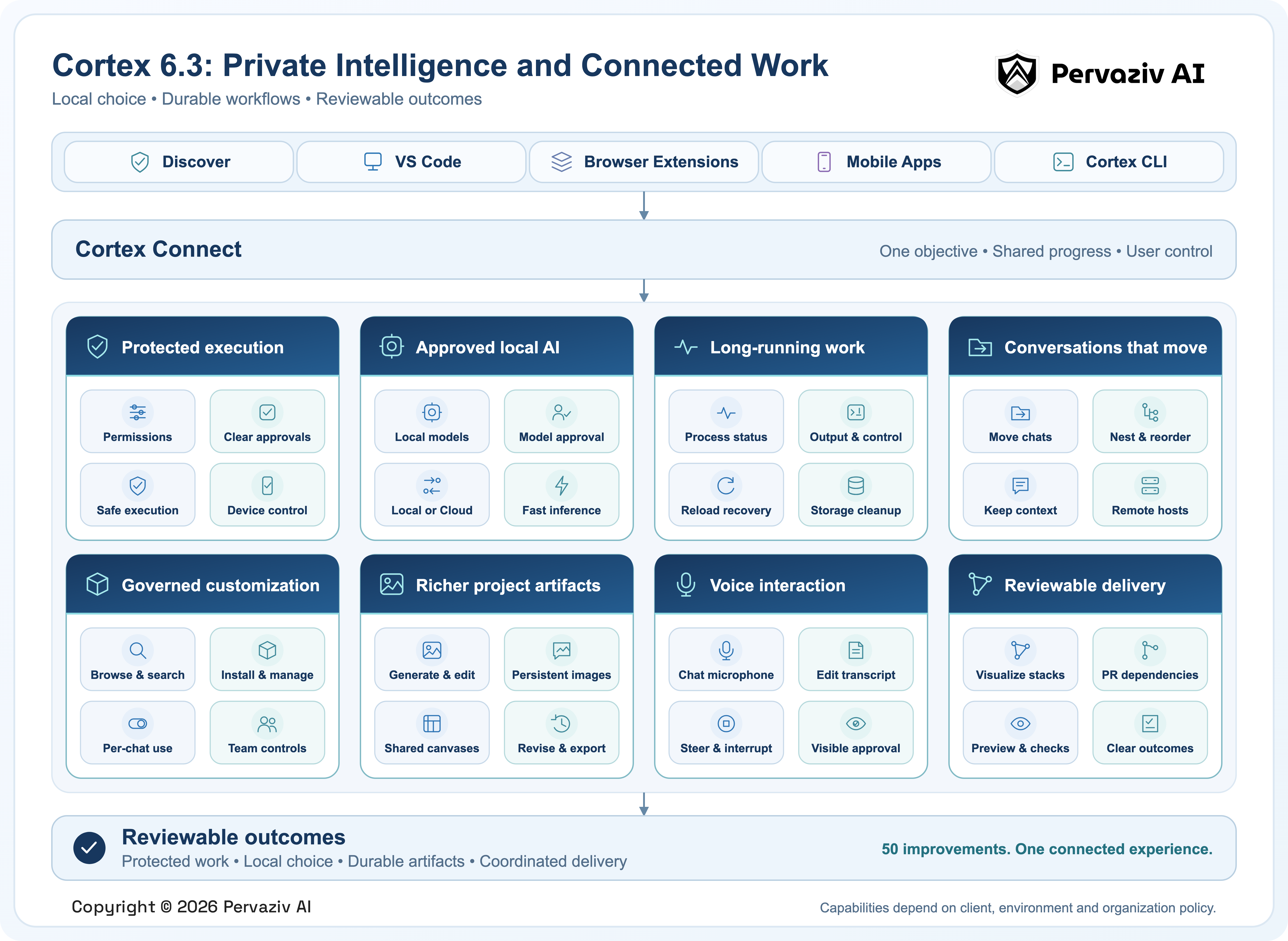
Pervaziv AI today announced Cortex 6.3, a major expansion of its Enterprise AI platform that brings private intelligence, protected execution and connected engineering work into a more continuous experience.
The release introduces 50 improvements across eight connected areas and advances Cortex beyond an assistant centered on individual responses. Cortex 6.3 is designed to help engineering teams move from intent to execution, from execution to review, and from review to durable outcomes while preserving the boundaries that enterprises need around models, environments, approvals, artifacts and consequential actions.
Software work rarely stays inside one prompt, one window or one machine. A developer may begin with a question, continue by running a build, move into a remote environment, review a visual or architecture plan, ask for a security analysis, wait for a long running test and finish with several related pull requests.
Traditional AI interactions often fragment that path. Context is rebuilt. Background work becomes difficult to follow. Local intelligence is introduced without enough organizational control. Useful artifacts disappear into transcripts. Remote environments feel disconnected from the conversation that initiated the work.
Cortex 6.3 focuses on closing those gaps.
“Enterprise AI becomes more valuable when intelligence can move with the work without losing the boundaries that make it trustworthy,” said Anoop Jaishankar, Founder and CEO of Pervaziv AI. “Cortex 6.3 connects private intelligence, execution, artifacts and delivery into one governed experience, so teams can move faster without turning continuity into uncontrolled access.”
Private intelligence. Connected work. Durable outcomes.
A Safer Place for AI Work to Run
AI assisted engineering becomes more useful when it can inspect a project, run a test, start a development process, work with files or prepare a change. Those capabilities also create a need for clearer operating boundaries.
Cortex 6.3 introduces a more consistent protected execution experience across supported environments. Organizations can establish how protected actions should be handled, while users receive clearer prompts when a decision is required.
Lower risk work can proceed with less interruption where policy permits it. More sensitive actions remain visible and reviewable. If an environment cannot provide the protections required for a particular action, Cortex does not silently treat it as equivalent to a protected environment.
This gives teams more flexibility without making convenience an invisible expansion of authority.
Organizations can use stricter confirmation requirements in tightly governed repositories while allowing routine operations to proceed more smoothly in controlled development environments. Policy remains able to narrow what is available, and the experience reflects the actual capabilities of the client or machine being used.
Approved Local Intelligence, Not Uncontrolled Local AI
Cortex 6.3 also expands the role of local intelligence.
Cloud models remain important for broad capability, scale and access across devices. At the same time, some organizations want selected AI requests to run closer to the code, reduce routine cloud usage, support offline work or evaluate smaller specialized models on developer controlled machines.
Cortex 6.3 introduces an approved local route for supported development hosts.
Users can discover eligible local models and request access through a guided workflow. Administrators can approve a specific model for an individual requester or for broader organizational use. The approval remains limited to the model and scope that was reviewed.
The chat experience makes the route visible and allows users to choose between approved local intelligence and cloud intelligence where policy permits. Cloud remains the default, while organizations can prefer local execution or require it for selected use cases.
A local only choice does not quietly fall back to the cloud if an eligible local route is unavailable.
Cortex also distinguishes between a model that is installed and a model that has been approved. Presence on a machine does not automatically make a model eligible for sensitive company work or broader agent capabilities. Its available role remains proportionate to its approval.
That distinction allows enterprises to benefit from open and locally hosted models without assuming that every downloaded model should be trusted equally.
Long Running Work Becomes Part of the Experience
Many meaningful engineering tasks take longer than a chat response.
A test suite may run for several minutes. A local service may need to stay active while another part of the application is inspected. A build may continue while the user moves to another window. A failed process may need to be restarted without reconstructing the original command.
Cortex 6.3 gives that work a clearer lifecycle.
Supported development environments can show active and recently completed processes, provide bounded output and make stop or restart controls available where appropriate. A reconnect or window reload no longer has to make a running task feel lost.
The conversation can continue while longer work is active, and the task remains connected to the session that started it.
Process control also respects ownership and policy. A remote observer can see permitted status without becoming the execution host, and one session cannot casually take control of work owned by another.
Workspace Recovery Without Losing the Work
Parallel engineering work often creates additional managed workspaces. These are useful while a task is active, but they can accumulate over time and consume storage after a change is merged, abandoned or moved elsewhere.
Cortex 6.3 makes managed workspace storage easier to understand and recover.
Developers can review Cortex managed work areas, identify which items are active or protected and clean up eligible work. Organizations can apply retention guidance and understand storage pressure without exposing unnecessary local details to every client.
Conversations Move with the Work
A conversation may begin before the right workspace exists. A broad objective may later split into implementation, testing, security review and documentation streams. Work may need to move from a folder into a managed workspace or continue from another Cortex surface.
Cortex 6.3 improves how sessions relate to workspaces and to one another.
Users can organize related sessions, create nested work and move eligible conversations to another workspace while preserving surrounding context. Parent and child sessions remain understandable without requiring every thread to share the same execution context.
Governed Customization for Enterprise Workflows
Organizations increasingly want AI systems to reflect their own tools, review practices, services and engineering standards.
Cortex 6.3 introduces a governed customization experience for approved agents, skills, tools, connectors, workflows and interactive views.
Users can browse what their organization has made available, install compatible capabilities, enable them only where needed and remove them when they are no longer useful. Administrators can curate private offerings, assign required capabilities, control updates and revoke a package when necessary.
Remote Development Becomes a Natural Execution Context
Modern software development frequently happens somewhere other than the local laptop.
Teams work through remote servers, development containers, Linux environments, tunnels, managed cloud machines and specialized hosts. Requiring developers to recreate their AI setup for every environment introduces friction and confusion about where work is actually running.
Cortex 6.3 makes the current supported development environment the natural execution context.
When a developer is already connected through a supported remote workflow, Cortex can use that workspace without requiring a separate setup file. Optional organization managed agent hosts can also be assigned for work that needs to continue away from the current editor.
Other Cortex clients can observe, steer or approve eligible work on those hosts without claiming local access they do not have.
From Code to Richer Project Artifacts
Engineering work produces more than source code.
Architecture diagrams, interface concepts, documentation visuals, threat model illustrations, implementation plans and review findings often emerge from the same discussion that produces code and tests.
Cortex 6.3 brings image generation and editing into supported Cortex experiences. Users can create a visual from a natural language request, work from an existing image or generate a variation. In supported development environments, the completed image remains connected to the conversation instead of becoming a separate, temporary experience.
The release also introduces interactive canvases for plans, threat models, architecture and findings. These canvases can remain associated with Cortex sessions, preserve revisions and recover after reconnecting, turning planning and review material into durable project artifacts rather than transient chat output.
Voice Becomes Part of Normal Chat
Cortex 6.3 adds microphone input to the normal chat composer on supported clients.
Users can speak a request, review the recognized text, edit it if necessary and send it as an ordinary chat message. The resulting turn is stored and restored like any other part of the conversation.
The design keeps text as the visible source of intent. Spoken input does not silently authorize a consequential action. When a protected decision is required, the user still receives a clear visual control.
Reviewable Delivery with Pull Request Stacks
Large software changes are often easier to review as several dependent pull requests.
One change may introduce a foundation, another may build on it and a third may complete the user facing behavior. Standard pull request tooling often presents those items independently, making dependencies harder to track.
Cortex 6.3 adds support for pull request stacks.
Users can view relationships among dependent changes, validate their current state and prepare coordinated updates. Cortex rechecks relevant repository state before consequential changes and presents the intended update for review.
If an external operation completes only in part, Cortex reports the surviving state rather than presenting the entire stack as complete. Retries are designed to avoid duplicating an action that already succeeded.
50 Improvements, One Connected Direction
Across protected execution, approved local intelligence, long running work, workspace recovery, conversations, customization, project artifacts, voice and delivery, Cortex 6.3 introduces 50 individual improvements.
The larger story is not the number.
It is the direction.
Cortex is available across development tools, browsers, Cortex Discover, mobile, command line experiences and managed environments. Cortex 6.3 does not pretend that every surface can safely perform the same actions.
A phone can review or steer permitted remote work without becoming a shell host. A browser can show which intelligence route was used without claiming it can run a desktop model. A supported development environment can execute locally when the required protections are available. Administrators can establish policy without receiving the contents of every conversation.
That capability aware approach allows the experience to stay connected without flattening meaningful differences among devices and environments.
From a Helpful Response to a Durable Outcome
The value of AI in software engineering is not measured only by how quickly it produces an answer.
Teams also need to understand where work ran, whether it is still active, what artifacts it produced, which environment owns it, whether local intelligence was approved and how a result can move toward review.
Cortex 6.3 brings those concerns into one experience.
A developer can begin with a cloud conversation, use approved local intelligence for an eligible request, continue in a remote workspace, monitor a long running test, create a visual or shared plan, speak the next instruction and prepare a related set of pull requests without turning each step into an unrelated tool handoff.
Organizations can provide that flexibility while retaining meaningful controls over execution, models, customizations, remote environments, providers and consequential actions.
Cortex 6.3 represents the next step in Pervaziv AI’s broader vision for Enterprise AI: intelligence that remains useful beyond the prompt, connected across the work and governed according to the environment in which it operates.
Private where it should be. Connected where it needs to be. Durable enough to carry real work from intent to outcome.


