
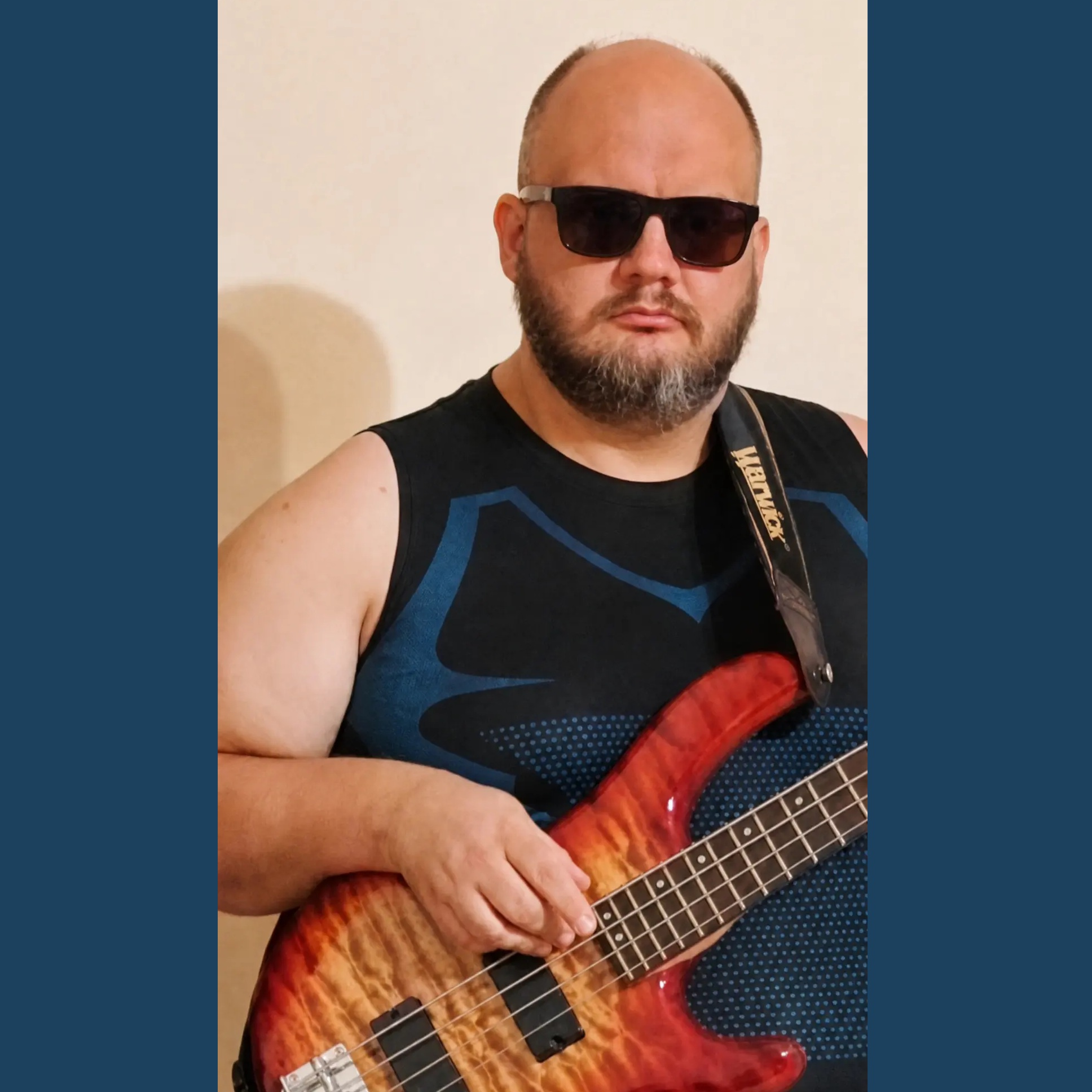
Gyor, Gyor-Moson-Sopron Sep 1, 2026 (Issuewire.com) Across 21 tracks, the Hungarian composer moves from a gallery of gods to a journey through the Nine Worldsrevealing serious engagement with the Eddas, a flexible command of modern metal, and a willingness to let myth become personal rather than merely picturesque.
Halfway through Mystic Melodies IV: Yggdrasil Brennt, Thomas Stonewell pauses over a detail too specific to have come from a superhero film or a generic Viking mood board: Álfheim was given to Freyr as a tooth-gift. The image, preserved in stanza five of the Eddic poem Grímnismál, becomes the hidden hinge of Weiss (Alfheim), a song that looks past the realms radiance to ask whether perfection without shadow can become sterile.[1] That choice tells us more about these records than any hammer, raven or drinking-hall chorus could.
Stonewells two predominantly German-language Norse-metal albums are interesting because the research does not remain decorative. It enters the sequencing, the points of view and, increasingly, the arrangements. Vol. 3: Von Asgard asks who these divine and monstrous figures are. Vol. 4: Yggdrasil Brennt asks how their worlds connect, what each realm costs, and how the entire structure can fail.
Release snapshot:
Mystic Melodies Vol. 3: Von Asgard
Release window: Late December 2025
Scope: 10 tracks; approximately 32 minutes
Language: Predominantly German; Hels Lament is in English*
Core form: Character portraits
Principal sound: Symphonic and power metal with melodic-death aggression
Mystic Melodies IV: Yggdrasil Brennt
Release window: Late February 2026
Scope: 11 tracks; 50:26
Language: German
Core form: Cosmological concept album
Principal sound: Symphonic metal broadened by industrial, folk and Neue Deutsche Härte-like weight
The streaming catalogs agree on each records track count, authorship and basic chronology, although they differ by two days on the exact release dates; the broader release windows above are therefore more defensible than false precision.* *Qobuz credits Stonewell as main artist, producer and composer on Yggdrasil Brennt, released through Stonewell Productions.* The public catalog credits do not supply a detailed session-personnel list or production account, so this review evaluates the released recordings and documented authorship rather than making assumptions about an undocumented workflow.
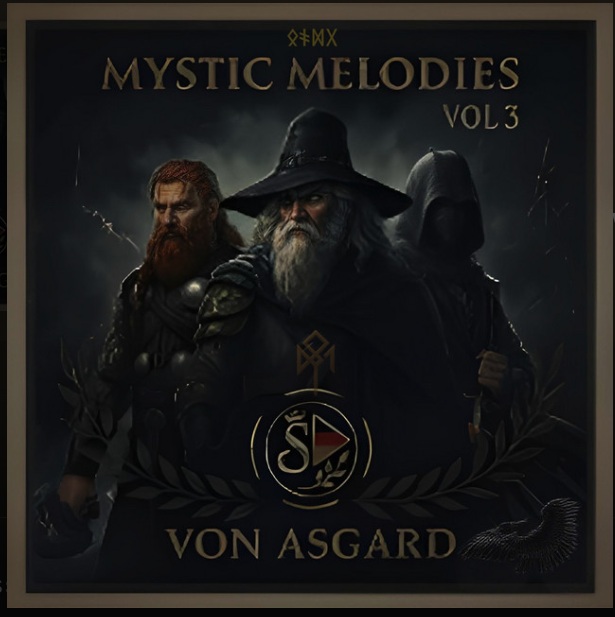
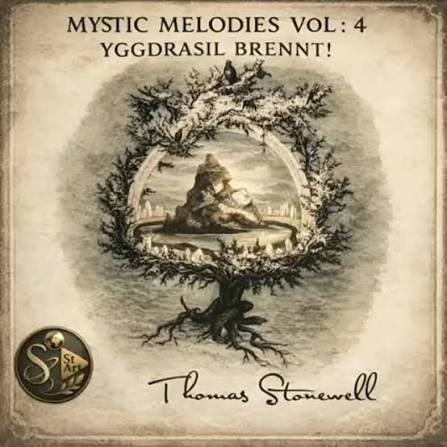
The artwork makes the conceptual growth visible. Von Asgard presents a dark, painterly group of mythic figures, with an aged, broad-hatted god at its center. Yggdrasil Brennt replaces that cast portrait with a parchment-colored world tree enclosing a distant landscape. The first cover introduces dramatis personae; the second proposes a map.*
A Composer Who Treats Viking Metal as a Language, Not a Costume
Viking Metal has never described one fixed sound as neatly as thrash or doom. Imke von Heldens chapter in The Cambridge Companion to Metal Music defines it as one of metals unusual categories shaped more by content and visual language than by a single sonic grammar: a Viking Metal record may musically belong to folk, death or black metal while its lyrics and imagery establish the Norse frame.* Stonewells stylistic mobility makes sense in precisely those terms.
There is little attempt here to imitate reconstructed medieval Scandinavian music. Instead, choirs, orchestral keyboards, compressed guitars, rapid double-kick patterns, clean baritone lines, female symphonic vocals, gang chants and death-metal growls operate as a modern dramatic toolkit. The precedent is broad rather than prescriptive: Bathorys Hammerheart, frequently treated as an archetypal Viking Metal album, established the value of literary ambition, choral scale and concept-album architecture without freezing the form forever.*
Stonewell also approaches the material from a distinctively Central European and German-language angle. Wotans Zorn uses Wotan, a recognized Germanic name-form of Odin, rather than treating Odin as the only authentic option.* The choice sounds natural beside the declamatory consonants and industrial march of tracks such as Thor Hammerherz and Das Werk (Svartalfheim). This is not borrowed Nordic identity so much as transnational metal storytelling.
His biography offers useful context without providing an easy explanation. A 2026 profile in the Hungarian regional newspaper Kisalföld reports that Stonewell began on accordion, played organ and served as a parish cantor while still in secondary school, later formed a choir with care-home residents in the United Kingdom, and worked with music therapy before returning to Hungary and establishing a creative mentoring studio. It would be simplistic to claim that church music directly produced these albums, but the attraction to massed voices, ceremonial pacing and organ-like harmonic weight is difficult not to notice.
Vol. 3: Von Asgard Ten Faces, Ten Compact Dramas
At roughly 32 minutes, Von Asgard is built as a row of mythic portraits. Baldr opens at speed, placing harsh vocals and melodic guitar work inside a compact symphonic attack. Its importance is narrative as much as musical: Baldrs death is not treated as a closed tragedy but as the crack through which Ragnarök enters. The Eddic Baldrs draumar likewise ties Baldrs fate to Hel, Lokis eventual release and the coming catastrophe.
The next two tracks take an unexpectedly sympathetic detour into Hels interior life. Hels Lamentthe one clearly English-language song across the pairuses a clean female lead and a colder, more spacious symphonic frame. Hel Ewige Königin returns to German and presents the ruler of the dead as both sovereign and prisoner. Repeating the character twice risks slowing an already short album, yet the doublinghas purpose: Hel is first heard as lament, then as office.
Loki Fluch der Masken is fast, theatrical power metal, while Frigga Die Stille Krone is more revealing. Rather than reducing Frigg to Odins consort, it centers her foreknowledge, silence and grief. Snorris Gylfaginning explicitly describes Frigg as knowing human fates while not speaking of them. Stonewell converts that restrained attribute into a character study, one of the records strongest examples of research guiding emotional perspective.
The albums middle-to-late sequence becomes increasingly physical. Heimdall Wächter der Brücke pairs harsh verses with a chantable choral hook, turning Bifröst and Gjallarhorn into musical signals. Fenrir Der Weltenwolf strains against its rhythm like the wolf against Gleipnir. Wotans Zorn crowds ravens, the sacrificed eye, runes, Valhalla and the tree ordeal into a furious miniature. The latter is especially well grounded: Hávamál describes Odin hanging for nine nights, wounded by a spear and given myself to myself, before taking up the runes.
Thor Hammerherz is the most immediately accessible anthem and also one of the most conventional. Its marching pulse and blunt hook do their job, but the writing rarely complicates Thor beyond strength, hammer and defense. The closing Freya Flamme und Fede is far denser. In less than three minutes, it invokes Brísingamen, golden tears, battle and Freyjas claim to half the slainthe last two details directly reflected in Gylfaginning.*
That density is both the albums signature and its limit. Stonewell can place an impressive amount of lore inside concise versechorus forms, but the recurring combination of orchestral swell, fast drums and large refrain sometimes makes distinct gods occupy the same musical room. The listener remembers the attributes before always remembering the riffs.
Vol. 4: Yggdrasil Brennt From Portrait Gallery to World System
The fourth volume is the more ambitious and more successful record because its 50-minute structure gives the research architectural force. The title track begins with the whole organism: roots, crown, Níðhöggr and Ratatoskr. From there, the album moves through a sequence of named realms and locations, ending with two different approaches to Asgard. It plays less like a playlist of mythological subjects and more like a guided descent and ascent through a cosmology.
That map should not be mistaken for an uncontested medieval diagram. Völuspá invokes nine worlds without listing them, while other Eddic passages name places inconsistently; Arkadiusz Sotysiak therefore warns that the sources do not preserve one homogeneous cosmological scheme.* Stonewells nine-stage route is best understood as an intelligently organized modern synthesisand its clarity is an artistic achievement in its own right.
Null Punkt (Niflheim) is the first major proof. Its cold atmosphere and growled vocals do not merely signify ice world; the song reaches toward Hvergelmir and the Élivágar rivers. Those names appear in Gylfaginning, where Niflheim predates the making of the earth, and Hvergelmir feeds the primordial streams.* Der Funke (Muspelheim) answers with brighter, faster power metal, Surtrs flaming sword and the destruction of Bifröst. The elemental opposition is obvious, but the sequence gives it narrative logic.
Ein Auge (Jotunheim) opens with an acoustic feint before becoming a harsh folk-symphonic drama about Odins eye at Mímirs well. Stonewell understands that the storys power lies not in the acquisition of wisdom alone but in its bodily price. The arrangement turns knowledge into a wound.
The albums finest stretch begins with Goldene Tränen (Vanaheim). Over folk-colored symphonic metal and a measured clean vocal, the song moves through the ÆsirVanir war, Njörðr and Freyr, the hostage exchange and Mímirs severed head before returning to Freyjas grief. The Ynglinga saga recounts the truce, the exchanged hostages, the Vanirs beheading of Mímir and Odins preservation of the speaking head.* These are not the franchise-ready details of Norse mythology. Their inclusion demonstrates readingor at minimum researchbeyond the most circulated names.
Weiss (Alfheim) goes further by turning its source detail into an argument. Alternating harsh male and clean female vocals, it presents light not simply as goodness but as a pressure toward spotless uniformity. The rare tooth-gift reference establishes the realm; the lyric then uses that world to question purity. This is where the project becomes more than illustrated mythology.
Das Werk (Svartalfheim) achieves a similar effect musically. Its industrial pulse, metallic repetition and Neue Deutsche Härte-like vocal weight make the arrangement behave like a forge. Mjölnir, Gungnir, Draupnir and Skíðblaðnir arrive not as trivia dumped into a lyric sheet but as products moving through a sonic workshop. The exact relationship among dwarfs, dark elves, Svartálfaheimr and Niðavellir is not perfectly stable across the medieval sources and later systematizations, but the tracks central conceit is dramatically coherent.
Midgard (Die Mitte) restores human scale through Ask and Embla, Ymirs eyebrows and Jörmungandr. Kein Weg Zurück (Helheim) then provides the albums atmospheric high point: whispers, growls and operatic choral layers enter a geography of gates, halls, Garmr and Baldr. Crucially, the medieval account sends to Hel those who die of sickness or old age; the familiar modern equation of Hel with moral disgrace is an oversimplification. *Stonewells language occasionally inherits that later moral coloring, but the surrounding place-names show that the underlying research is considerably deeper.
The closing Asgard diptych is an intriguing excess. Knie Nieder! Ich Bin Der Vater (Asgard) begins with a whistled, almost Western-film gesture before moving into a sinister industrial march. Odin is not a gentle patriarch but a ruler demanding submission. Knie Nieder Asgard restates the idea faster and more harshly. As a coda, the reprise intensifies the authoritarian portrait; as a separate eleventh track, it comes close to redundancy. The ambiguity feels appropriate for a god of kings, war, poetry, magic and deception.
Research, Reinvention and the Limits of Accuracy
These albums are source-conscious, not source-bound. That distinction matters. The title image Yggdrasil burns is a potent cinematic compression, but the central Ragnarök account in Gylfaginning says the world tree quivers while Surtr casts fire over the world.* One lyric in Fenrir Der Weltenwolf also appears to substitute Týrs heart for the hand Fenrir bites off in the standard story; if intentional, it is reinvention rather than textual fidelity. Jörmungandr surrounds Midgard and bites its own tail, but describing the serpent as literally holding the world together adds a modern symbolic function.*
Research test
Result
Uses details beyond Odin, Thor and Ragnarök
Decisively yes: Freyrs tooth-gift, Hvergelmir, Élivágar, the hostage exchange and the dwarven artifacts are central examples
Distinguishes characters through perspective
Often: Friggs silence, Hels burden, Odins bodily sacrifices and Freyjas grief receive individual treatment
Builds research into the music
Most successfully on Vol. 4: the Niflheim/Muspelheim contrast and the mechanical forge of Das Werk are structural, not merely lyrical
Maintains strict medieval-source accuracy
Noand does not need to: several images are compressed, moralized or reimagined for dramatic effect
Sustains musical variety across 21 tracks
Mostly: the palette broadens considerably on Vol. 4, though dense mastering and repeated epic-metal gestures reduce contrast
The factual verdict, then, is stronger than Thomas Stonewell knows Norse mythology. He knows enough to choose small, consequential details; enough to distinguish Grímnismál, Hávamál, Snorris cosmology and the Ynglinga saga tradition as reservoirs of different dramatic possibilities. He is also willing to depart from them. The research supplies load-bearing beams, not a museum display case.
The Verdict
Taken together, Mystic Melodies Vol. 3: Von Asgard and Mystic Melodies IV: Yggdrasil Brennt document a clear artistic expansion. The third volume is immediate, compact and character-driven. The fourth is longer, better paced and intellectually more adventurous, with its strongest songs discovering a sonic behavior for each realm rather than placing every myth inside the same epic-metal frame.
The production can be crowded, and several refrains depend on familiar symphonic-metal grandeur. Yet the pairs most important achievement survives those limitations: Stonewell treats mythology as a network of memories, prices and conflicting viewpoints. His gods are not simply strong; they know, grieve, bargain, build, deceive and fail.
For a Hungarian composer writing primarily in German within a genre historically centered on Nordic cultural memory, that is the genuinely interesting result. These records do not claim bloodline ownership over the material. They demonstrate something more durable: close attention, imaginative translation and the confidence to turn inherited myth into a personal metal cosmology.
Listen to Links:
Ygggdrasil Brennt Youtube Music
* Sources:
Edward Pettit, ed. and trans., The Poetic Edda: Grímnismál, stanza 5 (Open Book Publishers, 2023)
Deezer, Mystic Melodies Vol3 Von Asgard catalog, credits and track durations
Qobuz, Mystic Melodies IV: Yggdrasil Brennt catalog, credits, label and duration
Imke von Helden, Viking Metal: Obsessed with the Past?, The Cambridge Companion to Metal Music (2023)
Eduardo Rivadavia, Bathory: Hammerheart Review, AllMusic
Encyclopaedia Britannica, Odin
Dániel Viktória, Kántorból lett mentor, segíti a fiatal tehetségeket Gyr-Moson-Sopronban, Kisalföld (2026)
Edward Pettit, ed. and trans., The Poetic Edda: Baldrs draumar (Open Book Publishers, 2023)
Snorri Sturluson, Gylfaginning, in World Mythology, Volume 1: Gods and Creation
Edward Pettit, ed. and trans., The Poetic Edda: Hávamál (Open Book Publishers, 2023)
Snorri Sturluson, Ynglinga saga, Chapter IV, Samuel Laing trans., Wikisource
Thomas Stonewell, Hels Lament, official YouTube Music recording
Gaana, Mystic Melodies Vol3 Von Asgard release and catalog data
Deezer, Mystic Melodies IV: Yggdrasil Brennt release and catalog data
Arkadiusz Sotysiak, The Number Nine in the Tradition of the Norsemen, pp. 232233
Source :Stonewell Empire Limited
This article was originally published by IssueWire. Read the original article here.


