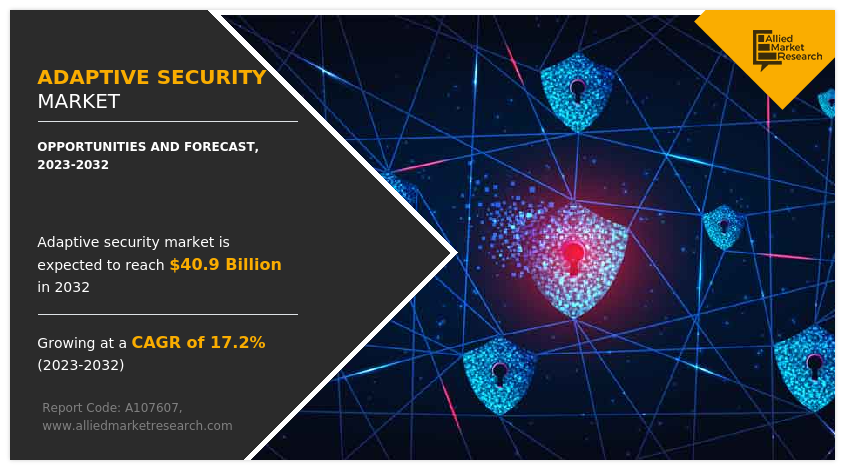
Adaptive security market is projected to hit $40.9 billion by 2032 driven by AI, cloud, and cyber defense demand.
WILMINGTON, DE, UNITED STATES, June 1, 2026 /EINPresswire.com/ — According to a new report published by Allied Market Research, the global adaptive security market size was valued at $8.6 billion in 2022 and is projected to reach $40.9 billion by 2032, registering a CAGR of 17.2% from 2023 to 2032.
The rapid increase in cyber threats, data breaches, and sophisticated digital attacks has accelerated the need for advanced cybersecurity solutions across the globe. Organizations are continuously searching for technologies capable of detecting, analyzing, and responding to security threats in real time. This growing need has significantly contributed to the expansion of the adaptive security market.
Download PDF Brochure: https://www.alliedmarketresearch.com/request-sample/A107607
Adaptive security refers to an advanced cybersecurity framework designed to identify, prevent, detect, and respond to evolving threats dynamically. Unlike traditional security systems that rely on static defense mechanisms, adaptive security continuously monitors user behavior, network activities, and endpoint operations to provide intelligent protection against modern cyberattacks.
The increasing adoption of cloud computing, artificial intelligence, machine learning, Internet of Things (IoT), and remote work infrastructure has further strengthened the demand for adaptive security solutions worldwide. Businesses operating across industries such as banking, healthcare, retail, government, manufacturing, and telecommunications are increasingly implementing adaptive security technologies to secure sensitive data and maintain operational continuity.
Rising Cybersecurity Threats Fuel Adaptive Security Market Growth
One of the primary factors driving the adaptive security market is the growing complexity of cyber threats. Modern cybercriminals are using sophisticated attack methods including ransomware, phishing, malware, advanced persistent threats, and insider attacks. Traditional cybersecurity systems are often unable to respond effectively to these rapidly changing threats.
Adaptive security systems use advanced technologies such as artificial intelligence and machine learning to identify suspicious activities and unusual behavior patterns in real time. These intelligent systems continuously learn from new threats and automatically adjust security measures to minimize risks.
As organizations increasingly digitize operations and migrate sensitive information to digital platforms, the importance of real-time security monitoring and threat response continues to grow. Enterprises are now prioritizing proactive cybersecurity strategies instead of reactive security models, which is expected to positively impact the adaptive security market during the forecast period.
Growing Adoption of Cloud-Based Security Solutions
Cloud computing has transformed business operations worldwide. Companies are rapidly moving workloads, applications, and databases to cloud environments to improve operational efficiency, scalability, and flexibility. However, this digital transformation has also increased cybersecurity concerns.
Adaptive security solutions play a crucial role in protecting cloud infrastructure by continuously monitoring user activities, network traffic, and cloud workloads. These systems help organizations identify vulnerabilities, unauthorized access attempts, and suspicious activities across cloud environments.
The cloud deployment segment is expected to witness significant growth during the forecast period due to advantages such as lower infrastructure costs, remote accessibility, automatic updates, and scalable security management. Businesses are increasingly preferring cloud-based adaptive security solutions to strengthen cybersecurity capabilities while reducing operational complexity.
Moreover, the growing popularity of hybrid work models and remote access technologies has further accelerated the need for advanced cloud security solutions, contributing to adaptive security market expansion globally.
On-Premise Deployment Maintains Strong Market Position
Based on deployment mode, the on-premise segment dominated the adaptive security market in 2022 and is expected to maintain a strong presence throughout the forecast period.
Many organizations, especially those operating in highly regulated industries such as banking, financial services, healthcare, and government sectors, prefer on-premise deployment because it offers greater control over sensitive data and security protocols. These organizations often require strict compliance with industry regulations and data privacy standards.
On-premise adaptive security systems enable enterprises to customize security frameworks according to organizational needs while maintaining complete control over infrastructure management. This deployment model is particularly beneficial for companies handling confidential customer information and mission-critical operations.
Although cloud-based security solutions are gaining popularity, the demand for on-premise adaptive security solutions remains strong among enterprises prioritizing data sovereignty and regulatory compliance.
AI and Machine Learning Revolutionizing Adaptive Security
Artificial intelligence and machine learning technologies are transforming the adaptive security market by enabling faster threat detection and automated response mechanisms.
AI-powered adaptive security systems can analyze massive volumes of data generated from networks, endpoints, applications, and users. These systems identify abnormal activities and predict potential cyber threats before they cause damage.
Machine learning algorithms continuously improve security performance by learning from historical data and emerging attack patterns. This allows adaptive security platforms to evolve alongside changing cybersecurity threats.
The integration of AI-driven analytics, behavioral analysis, and automation significantly reduces human intervention and enhances operational efficiency. Organizations are increasingly investing in intelligent cybersecurity solutions capable of minimizing response time and improving threat management capabilities.
As cyberattacks become more advanced, the role of AI and machine learning in adaptive security is expected to become increasingly important in the coming years.
Network Security Segment Leads the Market
By application, the network security segment accounted for the largest adaptive security market share in 2022. Organizations are heavily investing in network security solutions to protect digital infrastructure against unauthorized access, malware, and cyber intrusions.
Adaptive network security solutions continuously monitor network traffic and analyze communication patterns to identify anomalies in real time. These systems automatically adjust firewall rules, access controls, and security configurations based on threat intelligence and network conditions.
The rising adoption of connected devices, IoT ecosystems, and remote workforce infrastructure has significantly increased network complexity, making adaptive network security essential for modern enterprises.
Furthermore, organizations are increasingly implementing zero-trust security frameworks and advanced threat detection technologies to strengthen network protection and reduce cybersecurity risks.
Procure This Report (319 Pages PDF with Insights, Charts, Tables, and Figures): https://www.alliedmarketresearch.com/adaptive-security-market/purchase-options
BFSI Sector Generates Significant Demand
Among industry verticals, the banking, financial services, and insurance (BFSI) sector accounted for the largest adaptive security market share in 2022.
Financial institutions manage large volumes of sensitive customer information, digital transactions, and confidential financial records, making them attractive targets for cybercriminals. The increasing frequency of financial fraud, ransomware attacks, and phishing incidents has accelerated the adoption of adaptive security solutions within the BFSI sector.
Adaptive security technologies help financial organizations monitor transactions in real time, detect suspicious activities, prevent unauthorized access, and ensure regulatory compliance.
In addition, the growing popularity of digital banking, mobile payments, and online financial services has increased the need for advanced cybersecurity frameworks capable of protecting digital financial ecosystems from evolving cyber threats.
North America Dominates the Adaptive Security Market
North America held the highest revenue share in the adaptive security market in 2022 and is expected to maintain its dominance during the forecast period.
The region benefits from the strong presence of major technology companies, cybersecurity vendors, and cloud service providers. Companies such as IBM, Cisco Systems, and other leading cybersecurity firms continue to invest heavily in advanced adaptive security technologies.
The increasing frequency of cyberattacks targeting businesses, government agencies, and critical infrastructure has encouraged organizations across North America to strengthen cybersecurity investments.
Furthermore, the widespread adoption of cloud computing, artificial intelligence, big data analytics, and IoT technologies has created significant demand for adaptive security solutions across the region.
Supportive government initiatives, cybersecurity regulations, and increased awareness regarding data privacy are also contributing to adaptive security market growth in North America.
Asia-Pacific Expected to Witness Fastest Growth
Asia-Pacific is projected to register the highest growth rate in the adaptive security market during the forecast period.
Rapid digital transformation across countries such as China, India, Japan, South Korea, and Southeast Asian nations is driving cybersecurity demand across multiple industries. Businesses are increasingly adopting advanced technologies including cloud computing, IoT, automation, and artificial intelligence, creating greater demand for adaptive security solutions.
The expansion of smart cities, e-commerce platforms, digital banking services, and industrial automation projects has increased cybersecurity risks throughout the region. As a result, organizations are investing heavily in intelligent security systems capable of detecting and responding to cyber threats effectively.
In addition, rising internet penetration, growing smartphone adoption, and increasing government focus on cybersecurity infrastructure development are expected to create lucrative growth opportunities for adaptive security providers across Asia-Pacific.
COVID-19 Impact on Adaptive Security Market
The COVID-19 pandemic positively influenced the adaptive security market by accelerating digital transformation and remote work adoption worldwide.
During the pandemic, organizations rapidly shifted to cloud platforms, virtual collaboration tools, and remote working environments. This transition significantly increased cybersecurity vulnerabilities and created new opportunities for cybercriminals.
As a result, enterprises invested heavily in adaptive security solutions to protect remote networks, cloud infrastructure, and digital assets. The growing use of emerging technologies such as IoT, artificial intelligence, and automation further strengthened the demand for intelligent cybersecurity solutions.
According to industry insights, many organizations adopted digital transformation strategies to improve operational efficiency and reduce maintenance costs during the pandemic. The increasing reliance on digital ecosystems highlighted the importance of adaptive security frameworks capable of protecting businesses against evolving cyber threats.
Strategic Developments by Leading Companies
Major companies operating in the adaptive security market are focusing on product innovation, strategic partnerships, mergers, acquisitions, and business expansion to strengthen market presence.
Several cybersecurity firms are introducing advanced adaptive security solutions powered by artificial intelligence, machine learning, and automation technologies to improve threat detection capabilities.
For instance, Akamai Technologies introduced API Protector, a next-generation web application and API protection solution designed to provide intelligent automation and simplified security management for modern applications and APIs.
Leading players are also investing in cloud security technologies, endpoint protection platforms, and predictive cybersecurity systems to address evolving enterprise security requirements.
These strategic initiatives are expected to create significant growth opportunities within the adaptive security market over the next decade.
Competitive Landscape
Key players operating in the adaptive security market include Aruba Networks Inc., Cisco Systems Inc., Cloudwick Inc., Fortinet Inc., IBM Corporation, Juniper Networks Inc., Panda Security Inc., Rapid7 Inc., RSA Security LLC, and Trend Micro Incorporated.
These companies are continuously focusing on technological advancements, product development, and global expansion strategies to maintain competitive advantages in the rapidly evolving cybersecurity industry.
The increasing emphasis on intelligent threat detection, automated security management, and cloud-based cybersecurity solutions is expected to intensify competition among market participants in the coming years.
Get a Customized Research Report: https://www.alliedmarketresearch.com/request-for-customization/A107607
Conclusion
The global adaptive security market is witnessing substantial growth due to rising cybersecurity threats, increasing cloud adoption, and growing integration of artificial intelligence technologies. Organizations worldwide are prioritizing advanced cybersecurity frameworks capable of identifying and responding to evolving threats in real time.
The growing demand for intelligent network security, endpoint protection, cloud security, and automated threat management solutions is expected to drive adaptive security market growth significantly through 2032.
With continuous technological advancements and rising investments in digital transformation initiatives, the adaptive security market is likely to create substantial opportunities for cybersecurity providers, enterprises, and technology innovators across the globe.
Trending Reports in Energy and Power Industry:
Adaptive Security Market
https://www.alliedmarketresearch.com/adaptive-security-market-A107607
Smart Home Security Market
https://www.alliedmarketresearch.com/smart-home-security-market-A08889
AI in IoT Market
https://www.alliedmarketresearch.com/ai-in-iot-market-A12590
Artificial Intelligence in Education Market
https://www.alliedmarketresearch.com/artificial-intelligence-in-education-sector-market
Oil and Gas Data Management market
https://www.alliedmarketresearch.com/oil-and-gas-data-management-market
Asia-Pacific Smart Building market
https://www.alliedmarketresearch.com/asia-pacific-smart-building-market-A14204
Physical security market
https://www.alliedmarketresearch.com/physical-security-market
Threat Intelligence Market
https://www.alliedmarketresearch.com/threat-intelligence-market
North America Family/Indoor Entertainment Centers Market
https://www.alliedmarketresearch.com/north-america-family-entertainment-centers-market-A05970
About Us
Allied Market Research (AMR) is a full-service market research and business-consulting wing of Allied Analytics LLP based in Portland, Oregon. Allied Market Research provides global enterprises as well as medium and small businesses with unmatched quality of “Market Research Reports” and “Business Intelligence Solutions.” AMR has a targeted view to provide business insights and consulting to assist its clients to make strategic business decisions and achieve sustainable growth in their respective market domain.
Pawan Kumar, the CEO of Allied Market Research, is leading the organization toward providing high-quality data and insights. We are in professional corporate relations with various companies and this helps us in digging out market data that helps us generate accurate research data tables and confirms utmost accuracy in our market forecasting. Each and every data presented in the reports published by us is extracted through primary interviews with top officials from leading companies of domain concerned. Our secondary data procurement methodology includes deep online and offline research and discussion with knowledgeable professionals and analysts in the industry.
David Correa
Allied Market Research
+ + + + + + + + + + + + +1 800-792-5285
email us here
Visit us on social media:
LinkedIn
Facebook
YouTube
X
Legal Disclaimer:
EIN Presswire provides this news content “as is” without warranty of any kind. We do not accept any responsibility or liability
for the accuracy, content, images, videos, licenses, completeness, legality, or reliability of the information contained in this
article. If you have any complaints or copyright issues related to this article, kindly contact the author above.

Media gallery